
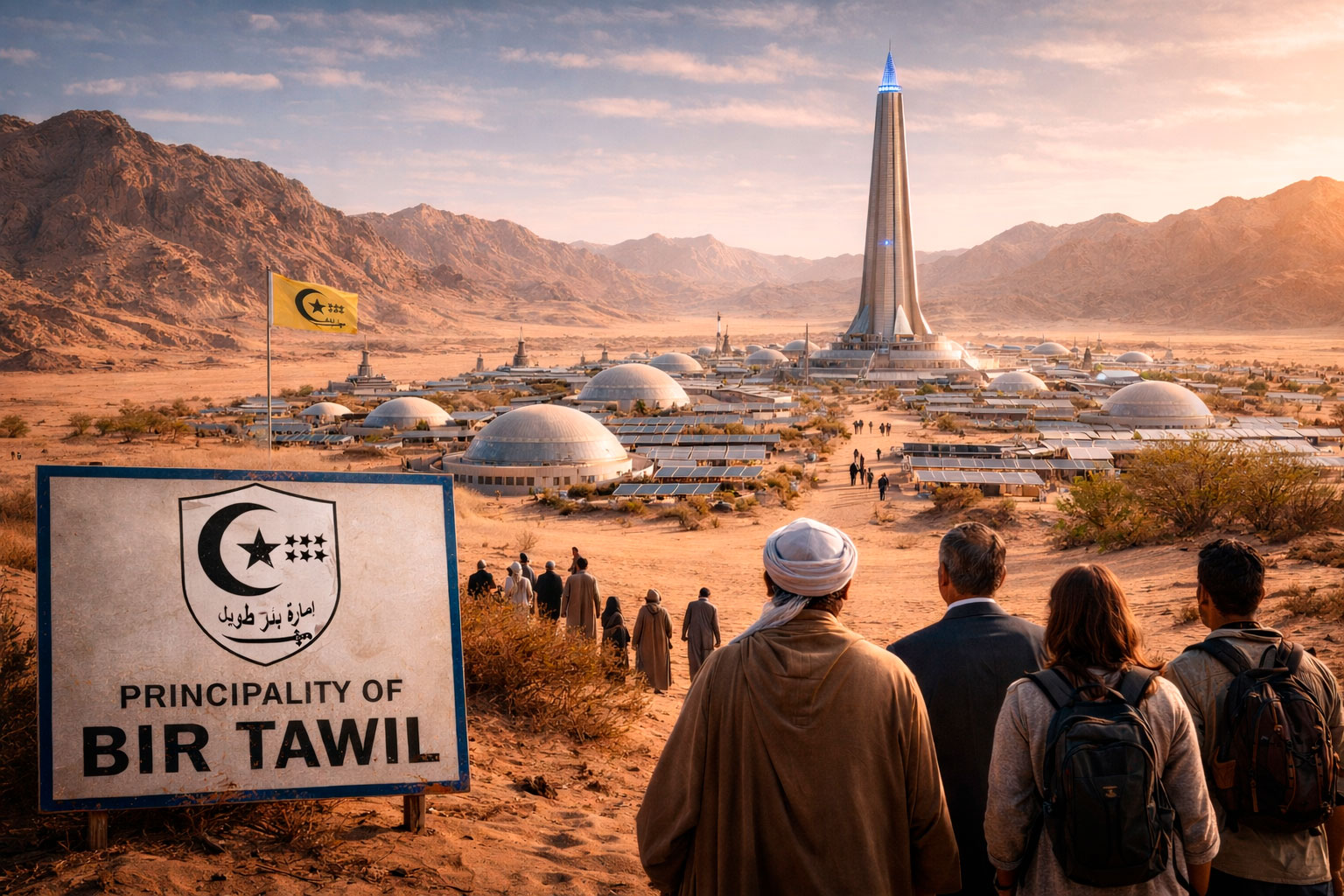
To become a Guardian and Citizen of Bir Tawil today is not an abstract gesture detached from reality; it defends freedom, restraint, and citizenship
Today global powers expand influence by annexing territories or installing pseudo governments, eroding autonomy; guardianship defends unclaimed spaces, preserves sovereignty, and protects a free world in restraint, dignity, and coexistence. Become a Guardian and Citizen of Bir Tawil is a response to the precise historical moment in which we are living.
The current geopolitical landscape is defined by fragmentation, accelerating conflicts, contested borders, mass displacement, and an ever-expanding tendency of states and corporations to transform land, identity, and even citizenship into instruments of power. In this context, the Principality of Bir Tawil stands as a rare anomaly, and the choice to become its Guardian and Citizen of Bir Tawil acquires a meaning that goes far beyond symbolism.
Bir Tawil is one of the very few places on Earth that is not claimed by any state. It exists outside formal sovereignty, not because it was forgotten, but because claiming it would weaken stronger territorial claims elsewhere. This legal vacuum has turned Bir Tawil into a geopolitical exception, a territory that exposes how artificial and strategic borders truly are. At a time when borders are increasingly weaponized, Bir Tawil quietly demonstrates that the world could exist differently, even if only in one fragile corner of the desert.
In today’s geopolitical climate, land is rarely just land. It is leverage. It is security. It is ideology. Conflicts from Eastern Europe to the Middle East, from Africa to Asia, show how territory is still treated as something to be seized, defended, traded, or sacrificed. Against this backdrop, Bir Tawil represents the opposite logic. It is land that remains outside conquest precisely because it offers no immediate strategic advantage. Yet this absence of value in conventional terms is what makes it invaluable in symbolic and ethical terms.
Protect your freedom by becoming Guardian and Citizen of Bir Tawil
Becoming a Guardian and Citizen of Bir Tawil is a way to engage with this contradiction. It is a conscious refusal to participate in the reflex that equates legitimacy with control. This form of citizenship does not promise protection, rights, or power. It does not grant a passport or a vote. Instead, it invites individuals to belong to a shared idea: that sovereignty does not need to expand endlessly to be meaningful, and that restraint can itself be a political act.
In an era where citizenship is increasingly conditional, transactional, and monitored, the idea of becoming Guardian and Citizen of Bir Tawil acquires particular relevance. Many states now treat citizenship as a tool of exclusion, surveillance, or economic selection. People are ranked by passports, filtered by visas, and defined by borders they did not choose. Citizenship becomes less about belonging and more about control. Against this trend, the citizenship associated with Bir Tawil is deliberately light. It does not replace national citizenship, nor does it compete with it. It exists alongside it as a reminder that belonging does not always need to be enforced by law.
This distinction matters deeply today. Millions of people are displaced, stateless, or living between borders. Others hold multiple citizenships but feel increasingly disconnected from the political systems that claim them. Becoming a Citizen of the Principality of Bir Tawil is not an escape from these realities, but a commentary on them. It says that citizenship can also be ethical, voluntary, and symbolic, grounded in responsibility rather than entitlement.
Guardianship adds another essential dimension. To be Guardian and Citizen of Bir Tawil is not about ownership. It explicitly rejects the logic of buying or owning land. In the modern world, land is almost always framed as property, investment, or resource. Even symbolic projects often replicate this mindset by selling plots, titles, or certificates that imitate ownership.
Guardian and Citizen of Bir Tawil
Guardianship breaks with that pattern. It recognizes that turning Bir Tawil into something that can be bought or owned would destroy the very condition that makes it meaningful. This is especially important in the context of Africa and post-colonial history. Much of the continent’s territorial structure is the result of external decisions imposed without regard for local realities.
Borders were drawn on maps, often ignoring the movement of nomadic peoples and the ecological logic of deserts, rivers, and seasonal routes. Bir Tawil itself is a by-product of such decisions. To respect Bir Tawil today also means refusing to repeat the same mistakes symbolically. It means acknowledging that local nomadic groups who cross the Nubian Desert have historically interacted with the land without claiming it as property.
The Ababda and Bishari tribes’ relationship with territory is based on movement, adaptation, and survival, not on ownership. Becoming a Guardian and Citizen of Bir Tawil therefore includes an implicit commitment to protect this way of relating to land.
It rejects narratives that describe the territory as “empty” in a way that erases human presence. It affirms that the absence of a state does not mean the absence of life, memory, or dignity. In a time when development projects, mining interests, and speculative claims often disregard local populations, this stance is not neutral. It is quietly political.
The current geopolitical situation is also marked by a crisis of trust. Trust in institutions, in governments, in international law, and in global organizations is eroding. Treaties are ignored, resolutions are bypassed, and power increasingly overrides principle. Bir Tawil, paradoxically, highlights this crisis by existing outside it. No international body governs it. No treaty resolves it. Its status depends on mutual disinterest rather than consensus.
Guardianship and Citizenship as a form of civic participation
In this vacuum, the idea of guardianship becomes a form of civic participation that does not rely on failing institutions. Becoming a Guardian and Citizen of Bir Tawil is therefore an act of civic imagination. It asks whether new forms of collective identity can exist without reproducing the structures that are currently under strain. It suggests that global belonging does not need to be mediated exclusively through states.
There is also a temporal dimension to this choice. The future of territory is increasingly uncertain. Climate change is altering coastlines, deserts, and habitable zones. Entire regions may become uninhabitable, while others may gain strategic importance. As environmental pressures grow, the temptation to claim, fortify, and exploit land will only increase. Bir Tawil, as a harsh desert environment, already shows what land beyond easy exploitation looks like.
Guardianship and Citizenship, in this sense, anticipates future debates about how humanity should relate to marginal, fragile, or extreme environments. Choosing to become a Guardian and Citizen of Bir Tawil now is a way of intervening early in that conversation. It asserts that not all land needs to be absorbed into cycles of extraction and control, and that some spaces can remain as reference points for ethical limits.
This is not a romantic fantasy. It is a pragmatic response to a world approaching ecological and political thresholds. The public registry of Citizens reinforces this relevance. In a time of polarization and fragmentation, the registry brings together individuals from different countries, cultures, and political systems around a single, minimal principle.
It does not ask participants to agree on ideology, religion, or policy. It only asks them to acknowledge that Bir Tawil should remain unowned and respected. This minimal consensus is itself meaningful in a divided world.
Guardianship and Citizenship in an ethical sense
Importantly, this form of citizenship does not demand loyalty, sacrifice, or obedience. It does not replace existing identities. It coexists with them. In an age where identities are often forced into conflict, this layered approach offers an alternative. One can be Italian, Panamanian, Sudanese, Egyptian, or any other nationality, and still choose to be a Citizen of the Principality of Bir Tawil in an ethical sense.
The project does not dilute existing citizenships. It enriches the space around them. Ultimately, to become a Guardian and Citizen of Bir Tawil in the current geopolitical time is to engage in a form of quiet resistance. Resistance to the idea that power must always expand. Resistance to the notion that land must always be claimed. Resistance to the belief that citizenship must always be enforced.
Becoming a Guardian and Citizen of Bir Tawil, it is not resistance through confrontation, but through refusal. Refusal to turn Bir Tawil into a commodity. Refusal to erase local nomadic presence. Refusal to impose identity where absence still has meaning.
This choice will not redraw maps or stop wars. But it does something subtler and perhaps more enduring. It keeps alive the idea that the world can still contain spaces that are not fully captured by power. In a time defined by acceleration, conflict, and enclosure, becoming a Guardian and Citizen of Bir Tawil is a deliberate act of slowing down, remembering, and choosing limits.
That is why it matters now and why you should become Guardian and Citizen of Bir Tawil, no matter where you live.